

What We Leave Behind
When Outsiders Put Our Faith to Shame

What have we been formed by?
Not what we claim. Not what we put on a survey, or vote for, or argue about online, or post when something makes us angry. What have we actually been trained to do when we are excited, anonymous, tired, or finished, when no one is watching and the small thing is technically someone else’s job? That is the hour that tells the truth about a person, and it does not care what label he wears.
Two crowds recently answered that question on the same weekend, half a continent apart. And the answers could hardly have been more different.
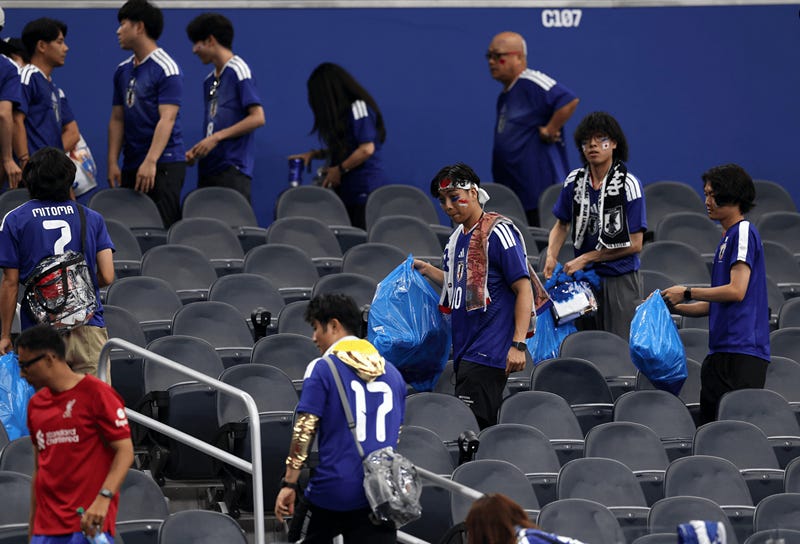
In Arlington, Texas, Japan came from behind to draw the Netherlands 2-2 in the World Cup, scoring late to rescue a game they could easily have lost. The Japanese supporters had every reason to celebrate and head for the exits. Instead, a whole section of them stayed in their seats after the final whistle, pulled out trash bags they had carried in for exactly this purpose, and worked their way down the rows. They picked up cups and bottles and wrappers, some of it theirs and plenty of it not, until the seats looked close to the way they had found them. The players did the same thing out of sight, leaving their locker room swept and folded and spotless. No one asked them to. There was no prize for it. They have been doing this at World Cups since the 1990s, and they did it again because it is simply what they were taught to do.
That same weekend, the New York Knicks won their first championship in fifty-three years, and a large part of the celebration in Manhattan turned into something close to a riot. Tens of thousands filled the streets, with the rowdiest clashing with police around Madison Square Garden and Times Square. Five school buses, which had been used to shuttle fans to the World Cup at MetLife Stadium, were either burned or destroyed. Police cars were smashed. Bottles were thrown at officers, ten of whom were hurt. A few nights earlier, after an earlier win in the same Finals, a crowd near Madison Square Garden swarmed a yellow cab, dragged out its driver, and punched him in the head while they smashed the windshield and tried to flip the car. He was a fifty-nine-year-old immigrant named Noureddine Bitat, ending a thirteen-hour shift in the vehicle he leased to feed his family. He says he may not drive again.
Most fans did none of this, and it would be unjust to pretend they did. But many others did, and their behavior wasn’t born from victory. The win didn’t transform them; it revealed them. Give a certain kind of person anonymity, a crowd to dissolve into, and a story that lets him call his impulses “celebration,” and he will show you what he is when he believes no one will hold him to account. Joy doesn’t vandalize. What moved through the streets of New York that night was a cultural instinct that no longer bothers to hide.
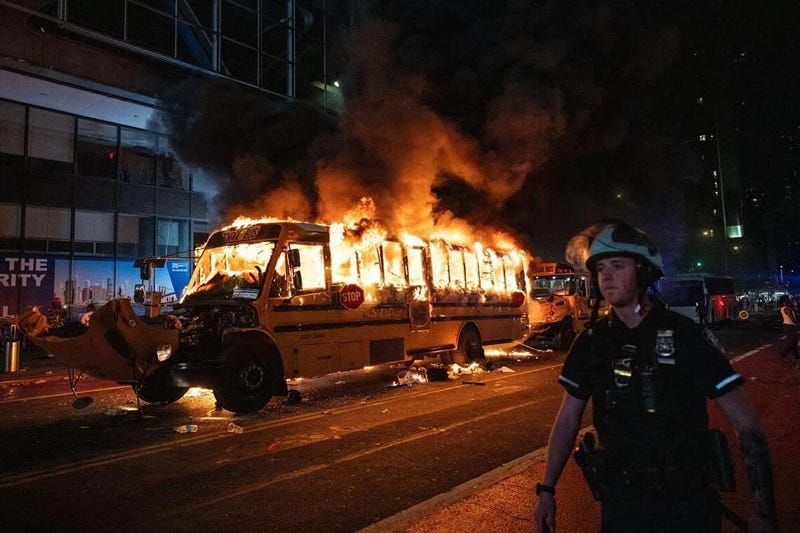
That behavior is not all of us. It might not even be in most of us. But it is still a fair picture of something real: a culture that has lost its center, still calls itself Christian on paper, and cannot keep this kind of lawlessness off its own streets after a ball game. The Knicks celebration worked like a spotlight, lighting up something we mostly prefer not to look at, while the Japanese fans only a few hours later made the contrast harder to ignore.
The truth is, both crowds were formed long before that weekend. The Japanese habit even has a name. They call it souji, the ordinary discipline of cleaning, and it is taught early, in schools where children sweep their own classrooms. The lesson follows people into adulthood: leave a place the way you found it. A borrowed space is a trust. By the time a person is grown, that has stopped being a rule he obeys and has become something closer to instinct.
The destructive part of the other crowd was formed too, by a quieter and uglier teaching. It is the lesson that a big enough feeling earns a man the right to stop considering anyone else. That celebration is its own permission. That the cost of your night belongs to whoever shows up in the morning with a broom. No one sat those people down and taught them that as doctrine. They soaked it up from the world around them until it became second nature, and then it came pouring out the moment the opportunity presented itself. What looked like chaos was really just formation, made visible.

Everyone is being formed by something. No one is neutral. We are being trained by what we watch, what we laugh at, what we excuse, what we reward, and what the people around us treat as normal, until those things become the reflexes we reach for without thinking. The fans in Texas and the crowd in New York showed, out in the open, what years of quiet training finally produce. And it leaves us with a question we rarely stop to ask about ourselves. Who, or what, has been discipling us?
Now set the two countries side by side. Only about one Japanese person in a hundred is a Christian. The faith has had a foothold there for almost five centuries, but it is still a tiny minority among a people shaped far more by Shinto and Buddhist practice, or by no religion at all. The United States, whatever its drift lately, is still a country where roughly two-thirds of adults will tell you they are Christian. We were founded by people who carried the Scriptures ashore with them. We print a confession of God on our money and swear our officials in on Bibles. By the labels we still like to use, we are the believing country and they are the mission field. Yet that weekend, the public conduct ran the other way.
The point is not that the Japanese fans were secretly Christian, or that tidying a stadium earns anyone a thing before God. It does not. A clean section of seats saves no one. But God scatters traces of His own order and decency and care through people who have never once bowed to Him, and He is willing to use those people to shame the ones who should know better. Sometimes the sharpest rebuke a careless church can receive is the plain conduct of someone standing outside it.
And the world is watching us right now, more closely than usual. For weeks, fans from all over the planet have been arriving for the World Cup and going viral over how warm and friendly America turned out to be. That should make us glad. It should also make us ask why so many expected worse in the first place. The picture the world holds of us gets assembled out of our loudest exports, and a night like the one in New York is exactly the kind of footage that travels. We tell everyone we are a Christian nation. Then we hand the planet a burning school bus and a cab driver standing in the street beside the wreck of how he feeds his kids.

There are no viral clips of Americans staying behind to clean a stadium after a Sunday football game. Most of us, Christian or not, would never even think to do it. The idea would not cross our minds. And that ought to bother us, because that kind of plain, unglamorous, nobody-asked-you goodness is exactly what our faith is supposed to grow in us, out where our neighbors and coworkers and the watching world can actually see it. We should be the people doing things a stranger cannot quite explain, things that make no sense from the outside, for reasons that run straight back to Christ.
James warned about a faith that never gets past the claim. “Faith by itself, if it does not have works, is dead,” he wrote (James 2:17, ESV). He was not saying good behavior earns us heaven. He was saying a living faith produces a visible life, the way a living tree produces fruit, and a faith that produces nothing has reason to wonder whether it is alive at all. Too many of us have quietly shrunk the word faithful until it means little more than showing up on Sunday, praying before dinner, giving what we give, and holding the right positions. We treat those things as the finish line, when Scripture treats them as the workshop. The practices of faith were meant to make us more like Christ. They were never meant to become a religious hiding place from the work of actually becoming like Him.
That concern sits behind one of the most overlooked lines in Paul’s letters. Writing to Titus, who was trying to bring order to a young and unruly church on Crete, Paul works through the household one group at a time. Then he lands on bondservants, the people at the bottom of that society, whose daily conduct the world would have been quickest to ignore. Even they, he says, in the ordinary faithfulness of their work, are doing something larger than they know. They are to live “so that in everything they may adorn the doctrine of God our Savior” (Titus 2:10, ESV).
That word adorn carries more than it looks like it does. The Greek is kosmeo, and translators come at it from a few directions. Some say adorn, some say make attractive, some say show the beauty of. Underneath all of them is one picture: arranging something so its real beauty can finally be seen. It is used of jewels set to catch the light, and of a temple decorated with fine stones. But it has a plainer use too, one most readers never hear about. It is the word for a house that has been swept clean and put back in order. When Jesus describes a life emptied of one evil and left “swept and put in order,” that is this same word, kosmeo (Luke 11:25, ESV). To adorn is to set a thing right, to restore its order, to make a space fit to be seen.
Put that next to a stadium full of strangers picking up trash, and something clicks. The fans were taking a space that had fallen into disorder and setting it right, so it could be handed on clean. Paul tells the lowest members of an ancient church that their lives are supposed to do the very same thing to the teaching of God. A Christian life sets the doctrine in order in front of a watching world. It either arranges the truth where people can see that it is beautiful, or it leaves the truth in such a mess that no one walking past would ever guess there was anything worth looking at underneath. The teaching is true either way. Our conduct decides whether anyone ever sees it. A life adorns the doctrine or it disfigures it.
There is no neutral setting where how we live has no effect on how our faith looks to the people around us.
Peter assumed the same thing. “Keep your conduct among the Gentiles honorable,” he wrote, “so that when they speak against you as evildoers, they may see your good deeds and glorify God on the day of visitation” (1 Peter 2:12, ESV). Watch the order there. The outsiders speak against the believers first, and what finally turns them toward God is a sight. They see the good deeds. The words Peter uses, kala erga, come from the same family as the works James said prove a faith is alive, and the same works Jesus pointed to when He told His followers to let their light shine “that they may see your good works and give glory to your Father who is in heaven” (Matthew 5:16, ESV). The pattern holds across all of them. The works are the evidence that a real faith has become a real life, and they are the form that life takes where the world can see it. The witness shows up before it is ever spoken.
Jesus pushed this harder than we like to admit. When an expert in the law asked Him to define a neighbor, He told a story in which a priest and a Levite, the men with spotless religious credentials, walked past a half-dead man in the road. A Samaritan, the outsider with the wrong bloodline and the wrong worship, stopped, bound the wounds, and paid the bill. The shock of the story was not that an outsider could be kind. The shock was that knowing the command guaranteed nothing about keeping it. A man could have the whole law by heart and still step over his neighbor in the dust. Jesus made the outsider the mirror and handed it to the people most certain they had nothing to learn.

He’s still doing it today. A crowd that does not name Him as their influence or claim Him as their God showed up in a foreign stadium and left it better than they found it, while a crowd from a nation that does name Him left a man weeping beside his wrecked cab. We are probably not the people burning the buses. That violence is one end of a long road, and most of us never travel that far. But the other end of that road is quieter, and far more crowded, and it is where most of us actually live.
It is the cart left in the middle of the parking space. The mess we walk away from because somebody is paid to deal with it. The shared thing we treat as someone else’s problem because we are tired, or busy, or just not interested enough to bother. We would never set a fire. Our version is duller and more respectable than that. We are self-centered. We are proud. We have decided, mostly without ever saying it out loud, that the world exists to clean up behind us. We assume no one cares, and the assumption reveals more about us than about the world.
We are very good at announcing what we believe. We are not nearly as good at leaving evidence of it. A nation that barely knows Christ walked into a stadium in Texas and, without trying to and without even knowing it, did the more Christlike thing, while the believing country set a bus on fire. We had every advantage they did not have. The American church has the Spirit, the Scriptures, the example of Jesus, and the command to love a neighbor. Yet in this moment, with the whole world watching, we came up short. That should sit with us long after the trophy is handed out and the streets are swept clean. It should sit with us hardest in the small, unfilmed places where no one is keeping score, because that is where we really live, and that is where it shows.
We will not leave better evidence by effort alone. Formation runs deeper than resolve, and the instincts we have built will not be undone by trying harder. But Christ can do what culture cannot. He can teach us to see the neighbor we would rather step over, to care when no one is watching, and to want what He wants until obedience becomes more than a duty and starts to become a reflex.
And when He does that, the change does not stop with us. It becomes the kind of quiet, ordinary goodness that reshapes homes and workplaces and neighborhoods. It leaves behind a cleaner room, a lighter burden, a neighbor helped, a place restored. It leaves a trail of small evidence that Christ has been forming us when no one was watching, and it gives the watching world a reason to believe that the gospel still produces a different kind of people.
This work is only made possible through reader support. If you’ve found this article meaningful or benefited from my work here, I invite you to prayerfully consider making a donation or becoming a paid supporter to help sustain and continue it.

We are the soft Christian nation which is soft on crime the same way we are soft on every other cultural issue. At risk of sounding cliche…when we stop STANDING for right, and enforcing it - we stumble. and fall on the wrong side of all these things. Because too many people say that being a Christian means that you are not showing love when you punish wrongdoing. Which is not true at all. And yet we allow that fallacy to continue.
Which makes us question…are we really still a Christian nation?
Thank you for this essay, Jason. It’s a solemn reminder that we as Christians need to stop looking the other way when opportunities to disciple others come along. Good conduct like the Japanese fans exhibited is learned behavior, and learning requires dedicated teachers. I noticed a great example of this principle in the book of Daniel, Chapter 3. I asked my pastor last Sunday why Daniel was missing from the fiery furnace incident. Nothing in the Bible or the commentary explains his absence. The pastor also didn’t have any idea why. I now think this passage exists to point to Daniel’s dedication to discipleship. He knew that God’s purposes and plans required his willingness to lead by example and teach others to do the same.