

Turn the Other Cheek
Why "Eye for an Eye" Was the Ceiling, Not the Floor

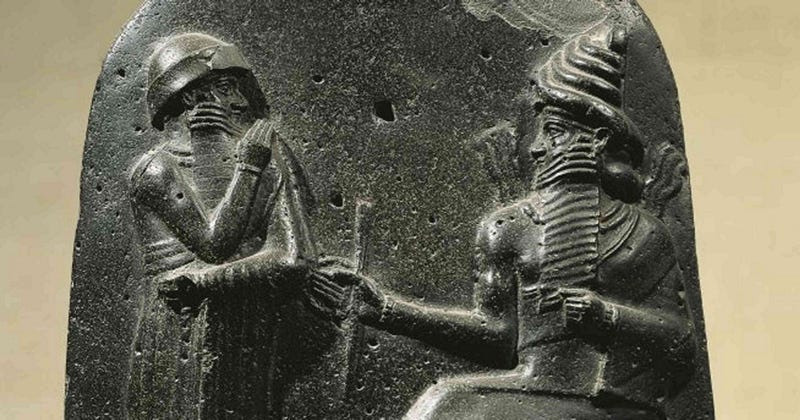
The principal we often refer to as “an eye for an eye” comes from Exodus 21:24, and it is one of the most misread sentences in the Old Testament. Most people hear it as a primitive license for payback. You hurt me, I hurt you. Fair is fair.
But “an eye for an eye” was never meant to make revenge easier. It was meant to keep revenge from becoming endless.
In the ancient Near East, a personal injury could ignite a blood feud that lasted for generations. One man wounds another, and the wounded man’s family retaliates not in kind but in excess. The cycle grows until one injury becomes many, and private vengeance becomes communal destruction. The law, known by its Latin name lex talionis, restrained that impulse by setting a boundary around justice. The punishment had to match the offense. No more. You could not burn down a man’s house because he broke your tooth. You could not kill a man’s son because he injured your eye. It was a ceiling, not a floor. A limit on vengeance, not an invitation to it.
By Jesus’ day, that legal limit had migrated from the courtroom into the street. What was designed to restrain judicial punishment had become a personal entitlement. People treated it as permission to get even. “He wronged me, so I have a right to wrong him back. The law says so.” The ceiling had become a target. Jesus is not lowering the standard of justice. He is exposing the way revenge learns to sound righteous.
That is the distortion Jesus steps into when He says:
“You have heard that it was said, ‘An eye for an eye and a tooth for a tooth.’ But I say to you, Do not resist the one who is evil. But if anyone slaps you on the right cheek, turn to him the other also.” (Matthew 5:38-39, ESV)
The phrase “But I say to you” is not a rabbi offering one more commentary on the law. The Greek includes the emphatic pronoun egō, a deliberate assertion of personal authority. Jesus is not correcting Moses. He is correcting what had been done with Moses. And what He says next has been misread almost as badly as the verse He is responding to.
“Do not resist the one who is evil.”
The Greek verb is anthistēmi, meaning to stand against, to oppose, to set yourself in opposition. Read in isolation, it sounds absolute. Never resist evil. But that reading collapses the moment you compare it with the rest of Scripture. James 4:7 uses the same word family to tell believers to “resist the devil.” Jesus Himself will overturn tables in the temple and confront the Pharisees with some of the hardest language in the Gospels.
What Jesus is forbidding here is not all opposition to evil. It is revenge-shaped resistance. The instinct that says, “You hurt me, so I have the right to hurt you back.” The examples that follow make this clear. Someone slaps you. Someone sues you. Someone forces you to walk a mile. Every scenario involves personal mistreatment and the temptation to retaliate in kind. But the most important detail in the passage is the one that modern readers almost always skip. The right cheek.
Jesus does not say, “If anyone strikes you.” He says, “If anyone slaps you on the right cheek.” In a predominantly right-handed culture, striking someone’s right cheek with your right hand requires a specific motion. The most natural way to do it is with the back of the hand. A backhanded blow. And in the ancient Mediterranean world, a backhanded slap was not primarily an act of violence. It was an act of contempt.
It was the gesture a master used on a slave. A Roman on a provincial subject. A superior on someone they considered beneath them. The blow communicated a message that went beyond pain: You are not my equal. You are not worth striking with an open hand. Historical-cultural commentators have often emphasized this distinction. The slap Jesus describes is not a fistfight or a mugging. It is a public act of humiliation designed to establish dominance and provoke a response. And in Jesus’ world, that response was not optional.

Roman-occupied Judea was built on a system of honor and shame that governed nearly every dimension of public life. A person’s honor was not a feeling. It was a social fact. It determined where you stood in your family, your village, and your synagogue. To have honor was to have standing. To lose it was to lose your place.
The system ran on a simple mechanism: challenge and response. If someone insulted you in public, the community watched to see what you would do. You were expected to answer. To return the blow, match the insult, or demonstrate in some visible way that you were not the kind of person who could be treated with contempt. A man who absorbed an insult without answering it did not earn admiration for his patience. He confirmed the insult. Silence meant the attacker was right. It meant you accepted the lower position. In a world where reputation was not a private matter but the currency of daily survival, failing to defend your honor was not humility. It was social death.
The cycle was self-perpetuating and almost impossible to escape. An insult demanded an answer, and an answer almost always invited escalation. Every unanswered blow was a loss of standing, and every answered blow invited another. A family quarrel could become a village feud. A personal slight could harden into a generational grudge. The system rewarded those who struck back and punished those who didn’t, and it called the whole process justice. This was the air Jesus’ listeners breathed. Most of them had never imagined there was any other way to live. And Jesus tells them to step outside it entirely. Turn the other cheek.
The Greek verb strepson is an aorist imperative, a direct command. An action rather than a collapse. And what the action communicates in the honor-shame world is extraordinary. By turning the other cheek, the disciple refuses to cower, which means they do not accept the insult as deserved. But they also refuse to retaliate, which means they do not enter the honor contest. They stand there, face forward, and say in effect: You can hit me again, but I will not become what you are.
Retaliation can look like strength, but often it means the aggressor has chosen your next move. The insult dictates the response. The aggressor sets the terms, and the wounded person enters the contest as expected. But the person who turns the other cheek refuses those terms. Their dignity is not on the table, because their dignity was never the aggressor’s to take.
Many of the people listening to Jesus knew what it felt like to be backhanded, literally or socially, by someone with power. They knew the expected response because the system had trained them since childhood. Answer strength with strength. Meet insult with insult. Defend your name or lose it. And Jesus, standing in front of them, says: You don’t have to do that anymore.
That is far more radical than the way the verse is usually taught. The popular reading says: be passive, don’t fight. But Jesus is saying something deeper: you are free. Free from the need to retaliate. The cycle of insult and escalation that the world calls strength actually enslaves everyone who participates in it, and Jesus is offering a way out. Your worth does not depend on winning every exchange.
The Sermon on the Mount makes clear where that freedom comes from. In the very next chapter, Jesus tells His disciples not to practice their righteousness in order to be seen by others. Their Father sees in secret. Again and again, the Sermon moves the disciple’s attention away from the watching crowd and back to the Father. When a person’s identity is grounded in the Father’s love rather than public reputation, the honor game begins to lose its power. The slap still hurts. But it no longer gets to decide who you become.
The Old Testament had already been moving in this direction. Proverbs 20:22 says, “Do not say, ‘I will repay evil’; wait for the Lord, and he will deliver you.” That is the older wisdom beneath Jesus’ command: vindication belongs to God, not to the wounded pride that wants to seize it for itself. But the strongest echo comes from Isaiah, where the Servant of the Lord says, “I gave my back to those who strike, and my cheeks to those who pull out the beard; I hid not my face from disgrace and spitting” (Isaiah 50:6, ESV). The image of the offered face, willingly exposed to insult, was not invented by Jesus. It lived deep in Israel’s prophetic tradition, already pointing toward a servant who would endure shame without retaliation.
Jesus takes that prophetic pattern into His own body. Matthew’s Gospel is constructed so that the teaching of the Sermon on the Mount finds its completion in the Passion. And this is where a detail emerges that most readers never notice.
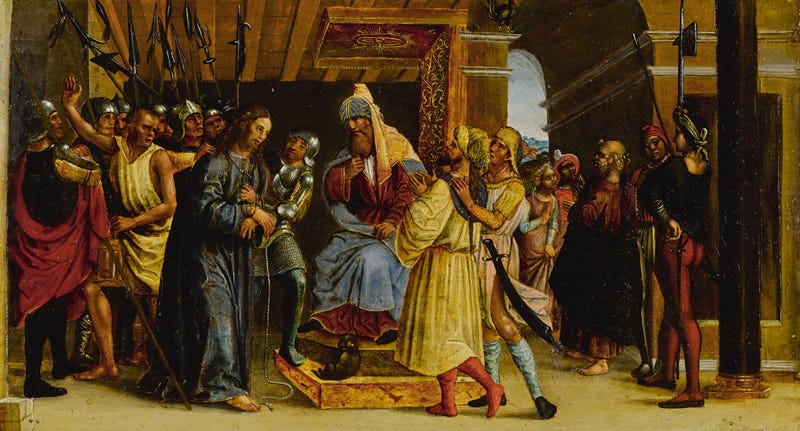
In Matthew 26:67, Jesus stands before the Sanhedrin after His arrest. The guards strike Him in the face. The verb Matthew uses is rhapizō, the same word that appears in Matthew 5:39 when Jesus says, “If anyone slaps you.” Matthew links the command Jesus gave to the blow Jesus received. The one who told His disciples to turn the other cheek now stands before His accusers and absorbs the kind of contempt He described. They slap Him. They spit on Him. They mock Him. And He does not retaliate.
John’s Gospel adds another layer. In John 18:22-23, when an officer strikes Jesus during the hearing before the high priest, Jesus responds. But not with a blow. “If what I said is wrong, bear witness about the wrong. But if what I said is right, why do you strike me?” That is not silence. It is not passivity. It is not surrender. It is truth spoken without revenge. It is exactly what turning the other cheek looks like when it is lived rather than theorized about. The disciple who follows this command is not someone who has nothing to say. They are someone who refuses to let the strike dictate the terms of their response.
The cross is the full picture. The world kept handing Him its violence, and He did not hand it back. He did not defeat evil by becoming better at evil. He defeated evil by remaining love in the face of it. And from the place of total public humiliation, He says, “Father, forgive them.”
Paul understood this. “Repay no one evil for evil... Do not be overcome by evil, but overcome evil with good” (Romans 12:17, 21, ESV). Peter says the same thing: Christ “did not revile in return; when he suffered, he did not threaten, but continued entrusting himself to him who judges justly” (1 Peter 2:23, ESV). The pattern is consistent across the New Testament. Evil is not overcome by imitation. It is overcome when the follower of Jesus refuses to let evil set the terms.
None of this means Jesus is commanding victims to remain in danger. Matthew 5:39 addresses personal retaliation, not the refusal to seek help, protection, or justice. The man who said “turn the other cheek” also confronted evil directly, walked away from hostile towns, and told His disciples to be wise as serpents. Non-retaliation is not the same as silence, and it should never be used to trap the wounded in the hands of their abusers.
What the verse does confront is the revenge instinct that lives inside everyone. Not just the impulse to throw a punch, but the subtler versions we have learned to justify. The cutting reply designed to humiliate someone who embarrassed you. The quiet campaign to damage the reputation of someone who damaged yours. The satisfaction of watching someone fail after they made you look bad. We may not live in the same honor-shame village world, but the instinct survives in comment threads, family conflicts, church disputes, and private conversations.
Jesus is not asking His followers to feel nothing when they are wronged. The disciple who turns the other cheek still feels the sting of the blow. They still know when they have been insulted, humiliated, or treated unjustly. But they have decided, deliberately and at great cost, that the wound will not be allowed to choose what happens next. Their response comes from the kingdom, from the Father’s assessment of their worth, and from the pattern of Christ.
This teaching is difficult because it reaches deeper than behavior. Retaliation lets me feel, at least for a moment, that I have taken something back. Jesus asks for a different kind of security. The person who retaliates is still living inside the honor system, still letting the aggressor determine the rules of the exchange, still needing to win in order to know they matter. The person who turns the other cheek has found something the honor system cannot offer and cannot take away: the gaze of the Father, which does not wait for the outcome of the contest to assign value.
The people who first heard these words lived inside a world that told them their dignity had to be defended by retaliation or it would be lost. Jesus told them the opposite. Their dignity was not earned by winning the exchange. It was not preserved by answering insult with insult. It was given by the Father, and it was given before the blow ever landed. Nothing the aggressor could do would change that.
He taught it because He was about to live it. And He lived it so His people could learn to live it too. The cheek that turns is not the sign of someone too weak to fight back. It is the sign of someone who has found a stronger place to stand.

Unearthed: The World of the Words Series
If you enjoyed this article, you may also want to read the other articles in this series:
Jesus Wept. Why Jesus Cried Before Raising Lazarus.
I Will Spit You Out. What “lukewarm” actually meant in Laodicea.
Why Do You Wait? The Baptism Verse People Keep Fighting Over
The Father Who Ran. Why One Verb Changes the Whole Parable
The Camel and the Needle. Why the Famous “Needle Gate” Explanation Is Probably Wrong
If you’ve found this article meaningful or benefited from my work here, consider making a donation or becoming a paid supporter to help sustain and continue it.
Oh, lots of food for thought there. Thank you.
“The cheek that turns is not the sign of someone too weak to fight back. It is the sign of someone who has found a stronger place to stand.”
• Psalm 91:1
He that dwelleth in the secret place of the most High shall abide under the shadow of the Almighty.
And Great, is The One, casting shadows 💪