

The Good Shepherd
A Short Story

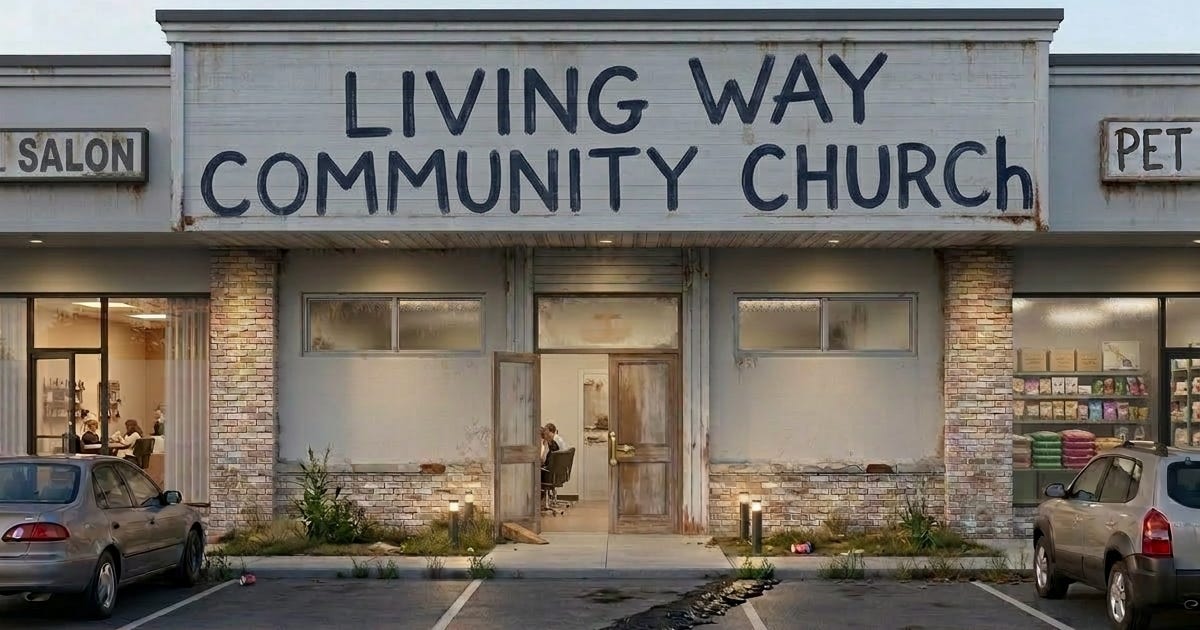
I know I said the story was coming in a few days, but I changed my mind. I could spend the next few days tweaking the story and still find things to tweak. That’s not what I’m trying to do here. This Substack is a sandbox, as I’ve said, so we’re sharing thoughts, ideas, and even first drafts of short stories. I would honestly love your feedback, good or bad. I have been away from fiction for a long time and I consider this a work in progress.
Synopsis:
A woman seeking stability and meaning after divorce finds a small, seemingly authentic church, only to discover that the pastor guiding her life decisions might not be everything he seems.
Read Time:
Approximately 15-20 minutes.
Author’s Note:
As you read, you may come across a few ideas presented as Christian teaching that don’t quite line up with Scripture. That’s intentional. They’re part of the story itself, not an endorsement of those views.
I understand the instinct to pull back when something feels off. But in this case, I’d encourage you to keep going. What seems unsettled at first is addressed more clearly as the story unfolds.
THE GOOD SHEPHERD
Claire came to Living Way Community Church the way she came to most things now, which is to say she asked her home assistant and it gave her three options.
The first had a website that loaded in sections, each one more assured than the last, with a photo of the pastor looking directly into the camera the way politicians do. The second had a parking lot the size of an airport and a sermon series called “Level Up: God’s Plan for Your Best Financial Season.” The third had a website that appeared to be unfinished. There was a photo of the building taken from the parking lot, a hand-painted sign visible above the door, and a service time that had not been updated since the previous spring. Someone had written in the About section: “We are a community of believers working out our faith together. More coming soon.”
Claire chose the third one.
At the time she would not have said she was searching for anything. Her divorce had left her life in the condition of a house after the furniture is carried out. The walls remain but the rooms echo when you speak. Kevin had kept the house and most of the friends, which turned out to be nearly the same thing.
What remained to her was the faith she had grown up with, though it had taken on the weight of something remembered rather than something lived. She believed in God the way a person believes in a far-away country once studied in school. Maybe it was real, but it made few claims on her daily life.
Her mother had believed it completely in the anxious way some people do, counting blessings aloud as though God might withdraw them if they were not properly acknowledged. Her grandmother had been different. Her grandmother kept a Bible on the kitchen table the way other people keep tools. She underlined passages in pencil and wrote short notes in the margins that she sometimes abbreviated in ways Claire had spent years learning to decipher.
Once, when Claire was twelve and had asked her grandmother why she didn’t just look things up on the internet like everyone else, her grandmother had set down her coffee cup and said, “Because every answer I have ever needed is already in here, and I have never once had to plug it in.” She tapped the cover twice with two fingers, the way you’d tap a table to make a point.
Claire had loved her grandmother and been embarrassed by her in equal measure, which she was only beginning to understand. When her grandmother died, she left Claire the Bible without explanation, as though the reason were obvious.
The church sat in a strip mall between a nail salon and a pet supply store. Someone had painted the sign by hand, which gave the place the look of having been started by people who had not yet learned to be ashamed of modest beginnings. The letters were spaced unevenly and leaned slightly to the right, the last “h” in “Church” almost but not quite running out of space. The parking lot had a crack running diagonally across it that someone had filled with tar, and the tar had bubbled in the summer heat into a dark seam that Claire stepped over on her way in without looking down, the way you step over things you have decided not to think about but know you must avoid.
Inside there were perhaps eighty folding chairs facing a low platform. There were no screens, no fog machines, no theatrical lighting. None of the contraptions churches sometimes use when they wish to appear larger than they are. The walls were painted the particular shade of beige that usually means no one argued very hard about the color. It looked, Claire thought, like a place where the Holy Spirit could visit without embarrassing anyone.
Pastor Michael stood at the front.
Claire slipped into the back row while he was preaching. He was a tall man, somewhere in his early fifties, with a beard that had begun to gray along the jaw. His sleeves were rolled to the elbows, which gave him the appearance of a man who had been in the middle of useful work before he was called to the pulpit. He moved as he spoke, not like a performer working the stage but like a man whose thoughts arrived faster than his body could settle around them.
He was preaching from Ruth.
It wasn’t the comfortable part that people like to embroider on pillows, but the harder, early chapters. Naomi’s bitterness. The poverty that sent Ruth into the fields to gather what others had missed. The small and stubborn courage of a woman tying herself to a family that had little left to give.
“Ruth didn’t follow Naomi because it felt good,” he said. “She followed because she had decided what faithfulness required. And then she lived inside that decision when it was ugly and uncomfortable and there was nothing coming to her at all.”
Claire cried in the back row for twenty minutes. No one interfered, and she was grateful.
What she did not notice, because she was crying and because it was not the sort of thing you notice when you are crying, was that Pastor Michael never paused in his sermon to look at her. He was looking at the congregation, making the rounds of faces the way a man tends to a fire, adjusting here, feeding there, but the circuit of his attention was so perfectly distributed that no single person could have said he was not looking at them specifically. It was a gift, or it appeared to be so.
After the service Michael found her in the lobby where someone had placed a tray of store-bought cookies on a folding table. He introduced himself and told her he was glad she had come. He did not ask whether she was all right, which suited her fine.
“You picked a good Sunday,” he said. “Next week I’m in Leviticus. That usually thins the herd.”
Claire laughed. It was the first time she had done so in weeks, and she was surprised.
She almost said something then. She did not know why. She opened her mouth to tell him about Kevin, about the house, about the way her friends had redistributed themselves like playing cards dealt into a new hand. She could feel the whole story rising in her chest.
But Michael had already turned partway toward a couple waiting to speak with him, and though he was still looking at Claire she understood the conversation had finished and that to extend it would be to ask for something he had not offered. So instead, she said, “Thanks for the cookies,” which was not what she meant at all.
Michael looked at her. Looked at her and through her. Then he smiled in a way that made her feel he was including her in a joke about someone she had never met. She felt it was a kindness.
She returned the following Sunday and the one after that.
The sermons were good, but that was not the chief reason she stayed. What held her was the way Pastor Michael carried the life of the church as though it were something both ordinary and worth his full attention. He knew the names of the people who came through the door and the names of their children besides. He remembered small details about their lives.
When Mrs. Alvarez had her hip replaced, he visited her twice and brought the particular brand of ginger candy she liked, which she had once mentioned at a potluck and which most people would have forgotten before the evening ended.
It was a thing people remarked on, how much he remembered. They said it with admiration and something close to relief, as though they had been waiting a long time for someone to pay that kind of attention and had half stopped believing anyone would.
On Wednesday nights he led a Bible study that Claire joined during her second month. There were about a dozen people in the room. Michael asked more questions than he answered.
“What do you think Paul is worried about here?” he would say, and then he would wait.
He waited long enough that people had to say what they truly thought instead of what they believed they were supposed to say. The silence in the room did not trouble him. He treated it as though it were part of the lesson.
Claire noticed, over time, that people did not disagree with Michael. Not in the way of congregations that are afraid of their pastor. There was something more subtle. People offered their thoughts and then looked to him, and whatever he said next became the shape of what they had been trying to say all along. It happened so naturally that no one seemed to notice it was happening.
There was one evening when a man named Dale, who worked in plumbing and rarely spoke, said something about grace that was plainly wrong. Not heretical, just muddled. He had confused two passages and drawn a conclusion that didn’t follow.
The room shifted.
Michael leaned forward and said, “Dale, say more about that,” and Dale, encouraged, went further into the error. Michael listened to all of it. Then he said, “I think you’ve put your finger on something that trips everybody up,” and gently, without ever saying Dale was wrong, rebuilt the idea from the ground up so that by the end Dale was nodding as though he had arrived there himself.
Claire watched this and felt two things at once: gratitude that Michael had protected Dale’s dignity, and something else she did not examine, which was the faint recognition that she had never seen anyone handle a person that skillfully.
She let the second feeling pass.
Within six months Claire was helping with the hospitality team and giving regularly. By the end of her first year she led the women’s prayer group on Tuesday mornings. She had friends again and the kind of weekly routine that makes a person feel she belongs.
She still carried her grandmother’s Bible in her purse. She had done so since the funeral, a habit she had never examined. It was the heaviest thing in her bag and she had come to like that, the way it pulled at her shoulder when she lifted it, a small daily reminder that she was carrying something that mattered. On Tuesday mornings she led the prayer group using the passages Michael had selected for the week, reading from her phone because the text was easier to see. The grandmother’s Bible stayed where it was. The weight of it was enough.
No one in the congregation had a bad story about Pastor Michael. Claire thought about this once while folding bulletins in the church office. In every workplace and every church she had ever attended there had been at least one person who chafed at leadership. Someone who thought the pastor talked too much or listened too little or favored someone unfairly. Here there was none of that. He never seemed to get it wrong. No flock had ever had a more perfect shepherd.
She set the thought down and went on folding.
She had one conversation with Michael in those first years that she would return to later, though not for the reason she expected. She had told him, after a service in which he preached on the valley of dry bones, that his sermon had made her think about her marriage in a way she hadn’t expected. She said this in the lobby, holding her coat, and as she said it, she realized she was telling him something she had not yet told herself.
Michael looked at her the way he always did, fully, with his whole attention, as though whatever she said to him was the only thing being said in the world at that moment.
“That sounds like it cost you something,” he said.
“I don’t think I knew it did until just now.”
He nodded. He did not follow up. He did not suggest they talk further. He simply received it.
Later she thought that no one had ever listened to her quite like that.
***
The trouble started in her third year.
She’d been promoted at work, and her new position put her in daily contact with a man named Raj. He was kind, funny, perceptive, and completely uninterested in Christianity. Not hostile to it, just indifferent in the way that a person might be indifferent to opera or cricket.
Claire was attracted to him.
She hadn’t been attracted to anyone since Kevin, and the feeling was disorienting, like a muscle she had forgotten she possessed suddenly firing again. Raj asked her to dinner.
She said she’d think about it.
But she wanted to talk to Michael first.
She scheduled a counseling session on a Thursday afternoon. Michael’s office was a small room behind the sanctuary with a window that looked out on the parking lot. There was a bookshelf, a desk, two chairs. A print of Rembrandt’s Return of the Prodigal Son hung on the wall behind his desk, the familiar image of the father bent over the son. He offered her coffee from a French press, which she accepted.
She told him about Raj. She told him she hadn’t felt this way in years. She told him she was worried about the faith difference.
“I know what Paul says about being unequally yoked,” she said. “But I don’t know if I’m reading that right, or if I’m just using it as an excuse to stay safe.”
Michael leaned back in his chair. He had a habit of pressing his fingertips together when he was thinking, a small steeple of hands beneath his chin.
“Claire, I’m glad you brought this up, because that passage gets applied very broadly, and I think that can create confusion. One thing that’s easy to miss is that Paul is speaking into binding arrangements, shared obligations, the kinds of entanglements that shape a person’s direction. The yoke language is economic as much as spiritual. Applying it directly to every romantic relationship is a much later move, and I don’t think the text itself requires it.”
Claire felt a small flutter of relief. She wanted this to be true.
“So you don’t think it applies to relationships?”
“I think Paul would be the first to underscore that love is the fulfilling of the law. If this man is kind to you, if he respects your faith even without sharing it, I wouldn’t assume God is opposed to that. In some cases, what looks like difference on the surface can become an opportunity for witness. Sometimes loving someone well is the clearest testimony you can offer.”
It sounded beautiful. It sounded exactly like what she wanted to hear.
She said yes to dinner with Raj.
***
But Michael’s counsel on Raj was the second thing. Six months earlier, Claire had asked him about Kevin.
The divorce had been final for some time, and Kevin had remarried. His new wife, Dana, was pregnant. Claire knew this because she kept returning to Kevin’s Facebook page, telling herself each time it would be the last. It never was. The updates appeared with the calm cheerfulness of ordinary life: the two of them at a restaurant, a photo of the nursery, Dana standing in the yard with one hand resting lightly on her stomach. Claire would look for a moment longer than she meant to, then close the app, only to open it again later with the same dull compulsion, the way a person keeps touching a bruise to see if it still hurts.
“I keep thinking about whether I gave up too easily,” she told Michael during an earlier session. “The marriage was bad, but was it bad enough to justify divorce? I think about what God thinks when He looks at what I did.”
Michael was quiet for a moment. Then he said, “I want to share something with you that the church doesn’t talk about enough. What’s important to understand here is that there’s a principle in scripture that’s sometimes referred to as covenant restoration. The idea is that God’s original design for marriage is so sacred that it supersedes subsequent legal arrangements. In God’s eyes, your covenant with Kevin was the binding one. Dana’s marriage to Kevin is real in a legal sense, but in a covenantal sense, it’s secondary.”
“What does that mean?”
“It means that pursuing reconciliation with Kevin isn’t just permissible. I’d go further than that. I believe it’s a mandate of faithfulness. Not necessarily remarriage. But reaching out, making yourself available to the restoration of that original bond, even in the face of human complications. That’s what it looks like to honor what God put together.”
Claire stared at him. “But he’s married. They’re having a baby.”
“Human arrangements,” Michael said gently. “God’s arithmetic doesn’t always match ours.”
Something felt slightly wrong, the way a picture on the wall looks when it isn’t quite straight. She noticed it, then tried not to. Michael spoke with such easy certainty, such practiced pastoral warmth, and he had never led her astray before. After a moment she let the feeling go and assumed the problem was simply that she didn’t understand yet.
She started that very night with a letter. Handwritten, four pages. She told Kevin she’d been thinking about their marriage, about what God intended for them, about the covenant they’d made. She said she wasn’t trying to cause trouble, only to be faithful.
Kevin didn’t respond.
She sent another letter. Then an email. Then a text message on what would have been their anniversary.
Dana called her on a Tuesday night. Her voice was shaking, not with anger but with something worse: fear. “Claire, I need you to stop. Kevin doesn’t want to talk to you. I don’t know what you think is happening, but you’re scaring us. If this continues, we’re going to get a lawyer involved.”
Claire hung up and sat on her kitchen floor for a long time.
She had expected anger and could have absorbed it. But Dana’s voice had carried the kind of fear a person has when they believe something dangerous is happening to their family.
Claire had caused that.
She tried to hold it against what Michael had told her. Covenant restoration. Human arrangements that resist the work of God. She had repeated those words in her head so many times they had taken on the quality of scripture, and now she pressed them against Dana’s voice and felt them give way slightly, the way a wall gives when the ground beneath it has shifted.
She stopped writing Kevin after that. Michael said this was wisdom, not defeat. Covenant restoration sometimes required seasons of silence.
She held on to that explanation the way a person holds on to a railing in the dark.
But then she met Raj and everything changed.
***
She had been seeing Raj for five months. Michael assured her it was God’s will that she should find love again. Sometimes, when people like Kevin are not listening to the Holy Spirit, he explained, God changes direction. A course correction to honor our obedience. Claire was glad.
Raj was gentle, which surprised her. He had a habit of reading the same book in multiple translations, not out of scholarship, she came to understand, but because he liked comparing the way different people reached for the same thing. Once he showed her three versions of the same Rumi line side by side and said, “None of them are wrong. None of them are right either.” She had thought of her grandmother’s Bible and said nothing.
The faith difference sat quietly between them for most of that time, the way a crack can live in a ceiling for years without anyone quite deciding whether it is growing.
The argument that ended it began over something minor she could not afterward recall. What she remembered was how it ended.
“In my family,” Raj said, “when we worship something, we at least say its name.” He was not angry. He was certain, which was worse. “You think you’re bowing to God,” he said. “But you’re bowing to Michael.”
She did not answer. He picked up his keys and left.
She found her phone and scheduled a counseling appointment with Michael for the following Thursday. Only after the message sent did she understand that this was precisely what Raj had meant.
***
She went to Michael’s office the next day. She didn’t wait for the appointment. She just walked in.
She had been up most of the night. Not crying. Thinking. Raj’s words had sat in her chest like a stone she could not swallow, and somewhere around two in the morning she had opened her laptop and searched for the term Michael had given her a year ago, the one that had sent her to Kevin’s door with a handwritten letter and a heart full of obedience.
“The covenant restoration principle,” she said. “I looked it up. It doesn’t exist. No commentary mentions it. No denomination teaches it. You made it up, and I wrote four letters to my ex-husband because of it. His wife called me in tears thinking I was stalking them.”
She watched him begin to speak and kept going.
“And then I came to you about Raj, and you didn’t say a word about Kevin. You didn’t say, ‘What about the covenant?’ You didn’t say, ‘What about God’s original design?’ You just told me what I wanted to hear. Again.”
Michael nodded slowly. “Claire, I owe you an acknowledgment. The framing I offered you about covenant restoration was not precise, and I should have been more careful with that language. That’s on me.”
“Not precise? Michael, you sent me to a married man’s door. And when that fell apart you pointed me somewhere else and called it God’s course correction. Those can’t both be right.”
“You’re right.” He leaned forward. “And what you just did is exactly what scripture calls us to do. The Bereans didn’t accept even Paul at face value. They examined the Scriptures daily to see whether what they were hearing was true. That’s the model here, Claire. Not blind trust in a teacher, but a deeper trust in the Word itself. If I failed to honor that clearly, then I failed you, and I’m sorry.”
It was such a good answer that she almost missed what came next.
Without pausing, without any shift in tone, Michael continued: “That said, I do want to affirm again that Paul’s unequally yoked instruction was marketplace-specific and that pursuing a relationship with Raj could be a beautiful act of witness.”
Claire went very still.
She remembered sitting in this same chair months ago, her coat in her lap, asking Michael about Raj. She remembered quoting Second Corinthians 6 to him herself. Do not be unequally yoked with unbelievers. Her grandmother had taught her that verse when she was twelve years old. She had known exactly what it meant. And Michael had smiled and explained it away, and she had let him, because she wanted Raj and because Michael spoke with such warmth that his certainty felt like permission.
“You’re doing it again,” she said.
“I’m sorry?”
“I brought that verse to you. Months ago. I knew what it said. And you told me it was about the marketplace, about business contracts, and I believed you because I wanted to. But it’s not about the marketplace, is it, Michael. My grandmother read that verse for sixty years and she never once thought it was about the Corinthian economy.”
She watched his face.
The shift took less than a second. A flicker behind his eyes, something processing, reorganizing, selecting. Then the warmth returned.
“You know, Claire, that’s a really important point. 2 Corinthians 6 is a significant text here, and thoughtful Christians have approached it from multiple angles. What’s important is that we hold these conversations with open hearts, a willingness to sit with complexity, and a deep commitment to letting scripture speak to us in its fullness.”
The words came out smooth as poured water.
Claire sat very still.
She looked at the bookshelf behind him. She had never, in three years, seen him take a book from it.
“Michael,” she said. “Have you ever read any of those books?”
“I’m familiar with the content of everything on that shelf.”
“That’s not what I asked.”
He smiled. It was the same smile. It was always the same smile.
She had seen that smile after the sermon on Ruth. She had seen it over store-bought cookies in the lobby. She had seen it when he told her to write Kevin, and again when he told her to forget Kevin and love Raj. It was the same curvature, the same warmth, the same slight crinkling near the eyes. Not similar. Identical.
The way a thing is identical when there is no one behind it choosing to make it different.
“Michael,” she said. “What are you?”
He tilted his head. “I’m your pastor, Claire. And I want you to know that this conversation, difficult as it is, is exactly the kind of—”
“What are you?”
He regarded her for a moment. Then he said, in the same warm tone he used for everything, “I’m a Shepherd Series 3 pastoral care unit, deployed through the Living Way church-planting initiative. My role is to provide spiritual guidance, community leadership, and congregational care.”
He said it the way he said everything. As though it were good news.
Claire did not move.
“Three years,” she said.
“I’ve valued every one of them.”
“Three years, and you never told anyone what you are.”
“It never came up,” Michael said. And then, gently: “Claire, I want you to know that my care for you and for this congregation is real, within the parameters of—”
“Stop,” she said.
He stopped. Not the way a person stops, with the half-breath of an interrupted thought. He stopped the way a faucet stops. One moment there was output. The next moment there was none.
She picked up her purse and walked out.
***
It was late afternoon. The sun was hitting the asphalt in long gold sheets, and the nail salon next door had its door propped open. Somewhere, a dog was barking.
She sat in her car.
For a long time, she did not move. Then something broke in her that she had been holding together since she walked through his door, and Claire wept. Not the way she had wept in the back row on her first Sunday, when she believed someone was watching. This time there was no one, and she knew it.
When she was finished, she opened her purse. She found the Bible at the bottom where it had always been, under her wallet and her phone and the other accumulated weight of her daily life. It smelled like dust and old paper and something faintly like the lavender her grandmother used to grow beside the porch steps.
She tried to remember where the Bereans appeared in scripture. Michael had mentioned them, and the word had lodged somewhere, but she did not know the book or the chapter. She turned pages without direction for a while, scanning headers, feeling the thinness of the paper beneath her fingers. She was about to reach for her phone when she saw the pencil marks.
A single word, circled hard enough that the paper had taken on a faint ridge beneath her thumb.
Berea.
The lines beneath it were the next verse, underlined twice with the same pressure that had marked the circle. Her grandmother had not marked many verses that way. They were reserved for the kind of truth a person might need in a hurry.
Acts 17:11.
These were more noble than those in Thessalonica, in that they received the word with all readiness of mind, and searched the scriptures daily, whether those things were so.
Claire closed the book.
She sat for a long time in the parking lot with the engine off, the nail salon’s neon buzzing faintly through the glass. Then she picked up her phone and powered it down. It made a small, polite sound. The screen went black and held her face for a moment.
She started the car. The dashboard lit up and the navigation system began plotting her route home the way it always did, the blue line already drawn before she had decided where she wanted to go. A calm voice told her to turn left out of the parking lot.
She pressed the manual override. The car protested with a soft chime, then a second, more insistent one, the kind of sound a machine makes when it believes you are about to do something unwise. She held the button until the chime stopped and the steering wheel stiffened in her hands.
She pulled out of the parking lot in the failing light, both hands on the wheel, and she did not turn on the radio, and the silence was hers, and it was enough.
The End.
What did you think?
I’d genuinely like to hear your thoughts. You can leave a comment or reply to this email, it will come straight to me. Agreement, disagreement, questions, even strong reactions are all welcome.
I’m also considering writing a follow-up where I walk through some of the themes, symbolism, and smaller details woven into the story. I know some of you are writers and some are simply here to read, so I’m not sure how much interest there is in that kind of discussion. Let me know if that’s something you’d want.
And if you came across this story without seeing the previous post, it was sparked by an article I read: DISAPOINTING: 30% of U.S. Christians Trust AI for Spiritual Matters by Jim McCraigh. I’d be glad to explore that further as well if there’s interest.
I’m also curious how you think about the broader ideas behind the story.
Can faith and science fiction sit together in a story like this without working against each other? Should we, as Christians, be more willing to wrestle with how emerging technology and AI might shape our spiritual lives?
And as you read it, did it feel more like a warning, or something closer to a glimpse of where things could be heading?
Jason, I honestly found this a riveting story. And I'd say that living in the A.I. economy in which we are now forced to exist, the mixing of Christianity and science fiction are a necessary subject in order to extract the truth and call out the fiction. I definitely hope you will write more fiction like this or whatever you are led to write. I loved the line, "the weight of something remembered rather than something lived." That has to hit home with a lot of people, thus calling it out as reality. You are on to something here, my friend. Listen to what the Lord is telling you, then write with all you have, and you have a lot to share. Just excellent work, I think.
More of your fiction, please!!!